An original poetic form created by Tristan Robert Lange
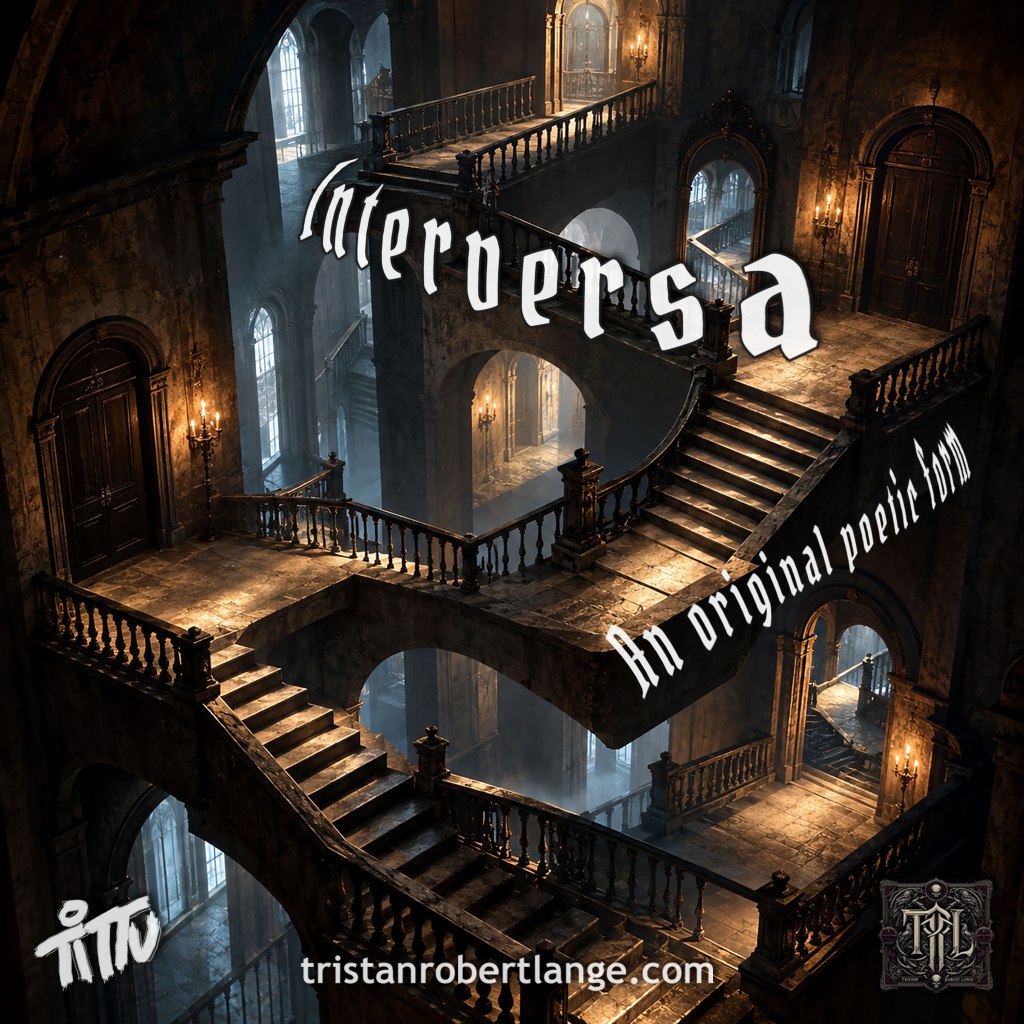
Welcome to the Interversa.
Created by Tristan Robert Lange in 2026, the Interversa is an original fixed poetic form built upon movement, recurrence, reversal, and interruption.
Four eight-line decasyllabic stanzas form the body of the poem. Before writing, the poet chooses four beginning words and four ending words. These anchor words alternate throughout each stanza and rotate as the poem progresses, creating repetition without requiring rhyme.
Between the four stanzas appear three interverses: brief textual disruptions written in reverse. Read backward, each reveals its intended statement. These interruptions are not ornamental; they participate in the poem by questioning, contradicting, revealing, disrupting, or otherwise interacting with the surrounding verse.
The result is a form in which order repeatedly encounters reversal before continuing forward.
The Interversa debuted in 2026 with “The Last Trick-or-Treater,” the first poem written in the form.
Rules of the Interversa
- The poem contains four eight-line stanzas, for a total of 32 main lines.
- Every main line contains exactly 10 syllables. No prescribed meter or stress pattern is required.
- Before writing, the poet selects four beginning words and four ending words.
- Lines 1, 3, 5, and 7 of each stanza begin with one of the designated beginning words.
- Lines 2, 4, 6, and 8 of each stanza end with one of the designated ending words.
- Each of the eight anchor words appears once in every stanza.
- The order of the anchor words rotates between stanzas, creating recurrence without keeping them in fixed positions.
- The four stanzas are separated by three interverses: one between each pair of stanzas.
- Each interverse is written in reverse so that reading it backward reveals its intended statement. Interverses are not governed by the 10-syllable requirement.
- The interverses should meaningfully interact with the poem through interruption, revelation, contradiction, questioning, transformation, or another purposeful relationship.
- No rhyme scheme is required. Rhyme may be used at the poet’s discretion.
Structural shorthand:
8 / interverse / 8 / interverse / 8 / interverse / 8
Concise description
The Interversa is an original fixed poetic form consisting of four decasyllabic octaves built around rotating beginning and ending words, separated by three reversed textual interverses.
The First Interversa
After the last hooligans knock—light’s out—
Halloween has ended for good this night.
Before succumbing to bed, I peer out
Of my windows observing the pitch dark—
Outside is an abyss of primal fear—
The shadows are consuming my whole porch.
Someone can be seen lurking—eyes glowing—
Standing right there as if alive, but dead.
.am I Here
Before I could think, I heard that cold voice
Uttering its guttural sounds in the dark
Outside my window in the great beyond,
Yet the sound is close, as if from my porch.
Someone—something—standing and haunting there;
A lurker with eyes, red, and standing dead.
After that horrid sight, I screamed in fright
And let out a curse upon the dark night.
.am I Fear
Outside, shadows are starting to shift my
Perception of things—shadows shift the porch.
Someone is smiling an awful green grin—
The fluorescent, jagged teeth of the dead.
After which my heart jumped up to my throat;
I start to fear my life forfeit this night.
Before I can look away—I must see
If I can recognize it in the dark.
.am I Death
Someone I know—I recognize their voice—
Is standing there taunting me as the dead.
After their last words, I have it nailed down!
Oh!—the horror of this shade in the night!—
Before the dawn shall break—Oh, the horror!
I will drop dead here alone in the dark—
Outside the earshot of a living soul—
For that fuck I buried ’s there on my porch.
© 2026 Tristan Robert Lange. All rights reserved.
First published on tristanrobertlange.com, October 1, 2026