Purpose
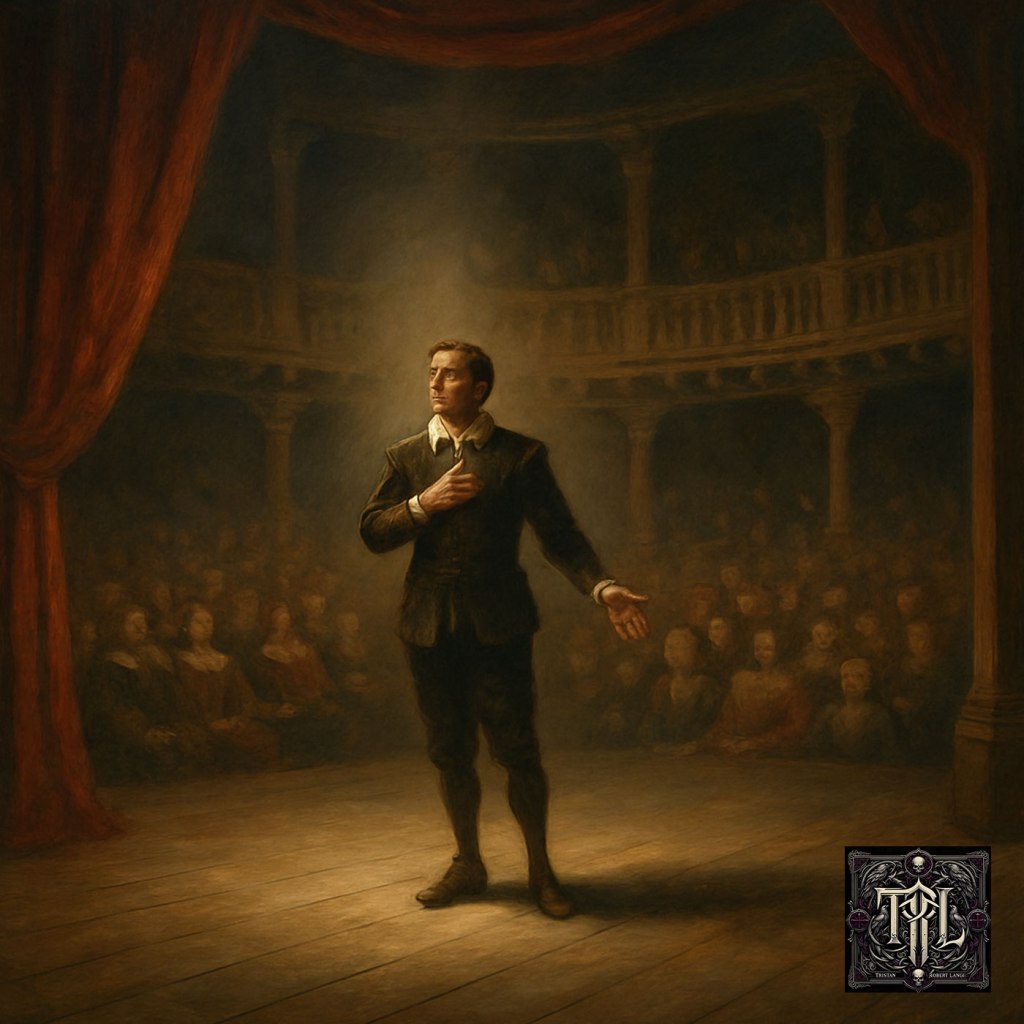
The Globe’s Stage is a composite poetic structure built to mirror the rise, fracture, and decay of both its subject. Modeled on the five-act arc of Elizabethan tragedy, it reimagines the sonnet not as a static lyric but as a living performance—one that begins in mastery and ends in silence.
Each act represents a distinct sonnet form and a corresponding stage in descent: the actor, once illuminated, loses control of the play; the structure that sustained meaning collapses; the performance outlives the performer.
Through this design, The Globe’s Stage becomes a meditation on mortality, repetition, and futility—on the human need to speak even as language itself fades. It asks what remains when form exhausts itself, when the curtain falls, and when the light that made the theater possible flickers out.
To write within The Globe’s Stage is to let the sonnet live, falter, fracture, and finally become its own ghost.
Structure
ACT I. Shakespearean — “The Spotlight Falters”
- Form: ABAB CDCD EFEF GG
- → Order, denial, and the illusion of control.
ACT II. Spenserian or Petrarchan — “The Mirror Cracks”
- Form (Spenserian): ABAB BCBC CDCD EE
or - Form (Petrarchan): ABBA ABBA CDE CDE
- → Fracture of self; structure tightening or reflecting upon itself.
ACT III. Miltonic — “No Intermission”
- Form: ABBA ABBA CDECDE (no volta pause)
- → Breathless continuity, syntax unbroken; the descent’s long slide.
ACT IV. Ghost — “The Hollow Stage”
- Form: 14-line echo of a Shakespearean sonnet; rhyme and meter thinning or eroding.
- → The sonnet’s spirit without its body; language becoming absence.
ACT V. Shakespearean — “The Curtain Falls”
- Form: ABAB CDCD EFEF GG
- → The return of rigid form only through extinction; the stage goes dark.
© 2025 Tristan Robert Lange. All rights reserved.


 Tristan Robert Lange