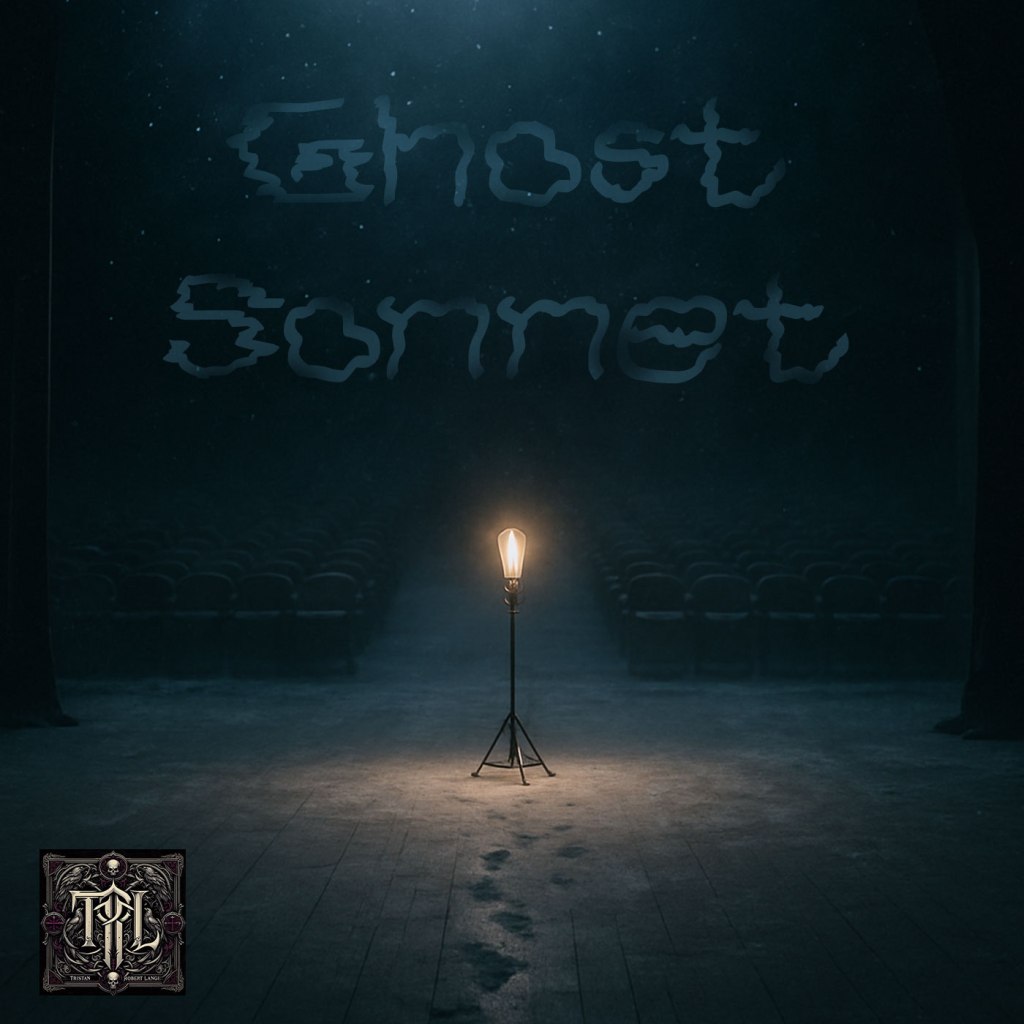
First used in Act IV: “The Hollow Stage” of my poem: “The Theatre of Dying Light”.
Purpose
To haunt the memory of the sonnet after its death.
The Ghost Sonnet preserves the outline of traditional form but lets rhyme, rhythm, and syntax fade—language itself becoming the specter.
Structural Rules
- Length: Exactly fourteen lines.
- The skeleton of a sonnet remains; it should still look like one on the page.
- Rhyme: Disintegrating pattern.
- Begin with hints of recognizable rhyme (e.g., ABAB).
- Allow rhymes to loosen, become near-rhymes, then disappear entirely by the end.
- Meter: Eroding pulse.
- Early lines may suggest pentameter; later lines may shorten or fragment.
- Rhythm should wane like breath in cold air.
- Syntax: Starts full and coherent, ends in fractured speech.
- Sentences trail off, ellipses appear, punctuation grows sparse.
- By the close, language may break into single-phrase or single-word utterances.
- Tone & Imagery: Absence and echo.
- Themes of dissociation, emptiness, or memory lingering after loss.
- Think of light on an empty stage, an echo in a dead hall, the self after performance.
- Final Movement: Silence enters.
- The last two to four lines should feel like disappearance—short, abrupt, or whisper-thin.
- A closing couplet may survive only as repetition or negation (“Go. Just go. / No show.”).
Spirit of the Form
- Where the Shakespearean sonnet celebrates order, the Ghost Sonnet performs entropy.
- It is the memory of structure, not its continuation—a poem that forgets itself line by line.
© 2025 Tristan Robert Lange. All rights reserved
Tittu


 Tristan Robert Lange