A Devilishly Dreadful Christmas Story
Poetry & Story: written by Tristan Robert Lange, Human-authored.
Field Log Entry: #9
Researcher:
Isabella Brenner, PhD.
Moravian University (Bethlehem, PA)
Date: Christmas Eve 2024
Time: 15:00
Time Zone: CET (UTC+1)
Coordinates: 50.57° N, 12.93° E
Location Description: Zindorf Ruins
Project Name: Castle Zindorf Excavation / Site ZD-01
Objective: To determine the nature and ritual practices of the religious community historically associated with Zindorf.
Time: 15:00
When I arrived at Zindorf castle, I had little idea what I would find apart from ruined battlements and moss-covered walls. Surely, the reputation of this formidable palace, now a mausoleum of macabre memory, preceded it as before me I could see nothing but what was to be expected, an empty abode that was dark where it should be light and where light oddly filtered into the infernal darkness.
I confess that as I begin to end writing for now and prepare to enter into this abscess of abomination—I chuckle out loud at that, for the legends are just too outrageous to believe—I don’t expect to find much more than the ghosts of water drops and the bones of rats. Still, an old rhyme comes to mind:
Beware the bones broken beneath—
Where Villeroy and his castle reside—
From them death’s shade shall bequeath
Your soul’s sacrilege through suicide.
Location: Choir Vault
Time: 15:30
Now seated in the choir vault with my lamp on, I record what happened leading up to this moment. It is actually hard to put into words—let alone process—what I have experienced so far. When I first entered the site and stepped into the great refectory, I was immediately filled with both awe and an indomitable dread. Of course, the dread clearly came from all of the legends and horror stories passed down over generations, but the awe was real and revelatory.
On first notice, as could be expected, the long, rectangular hall had hovering, vaulted ceilings and bore the Moravian simplicity one would anticipate. Very few ornaments, barring a cross above the dais, antithetical to Moravian theology, stationed at the far end of the center aisle before me. Yet, as I walked down the aisle through the hall, I began to notice strange markings in the wood beams above—burnt pagan engravings and symbols of death and fertility. It was also clear the dais, originally designed as a speaking platform, had been corrupted by the same markings. More shocking was the stone table jutting up out of the center, making it a dais once again.
I felt hair rise on my body in places I didn’t know it existed. What were those specific markings doing in an old Moravian community meal room? Vandalism was the only thing that seemed possible, but how would vandals find their way up there? A mystery for sure. And that table—did the count have that built? It hardly seemed likely, as it looked to be formed from the very rock the castle was built upon. Once I reached the large oak doors behind the dais, I hesitated, not knowing what exactly to expect on the other side.
Frozen there, gazing—pondering the possibilities—I slowly looked down and saw a carved wood panel that had fallen from the wall above the door. On it, these words were carved in German, translated to English here:
Our strong Lord, dear God, is so very sweet,
He blesses us with loaves, wine, and fresh meat,
We sing of his special place all day long,
As we do his work crafting holy song.Women raise his name on your voices high,
Now boys, follow suit, don’t you give a sigh.
Girls must sing like women,—proper and nice.
Our men, we wonder when, will…
Note: The final words of the carving seemed to be singed off with ashen ivy leaf-shaped burn markings left in its place. More curious graffiti? It always bothers me to see vandalism to such historical places and artifacts—why anyone would ever want to…I drifted deep into thought.
On the other side of that dastardly door, heavy and harrowing (as if they were trying to keep the Christmas cheer out), was what would be considered a prime example of late eighteenth-century Moravian design—there wasn’t much design at all. Whitewashed walls, hard, plain wooden pews that gave misery its meaning. It was a simple sanctuary, adorned with basic evergreen garland, plain wreaths, white candles, and advent candles.
Unlike the prior hall, this room had a certain paradoxical cold-warmth to it and, living and working in a historically Moravian city in Pennsylvania’s Lehigh Valley has made me particularly fond of the simplicity of a Moravian Christmas.
Let all the tired cometh here—
Bring women, children, friends.
Let all who hunger draweth near—
Their hurt the Lord upends.Weary traveler do not fear—
To all our song extends—
Sweet buns and hot coffee to cheer,
As our hearts make amends.
The words of that hymn suddenly appeared in my head, the memory from last year’s Moravian University Christmas Vespers service. It is amazing to me that even the revenant of real Moravian history can be experienced within modern day liturgy. Standing there in that chapel gave me that sense of connection.
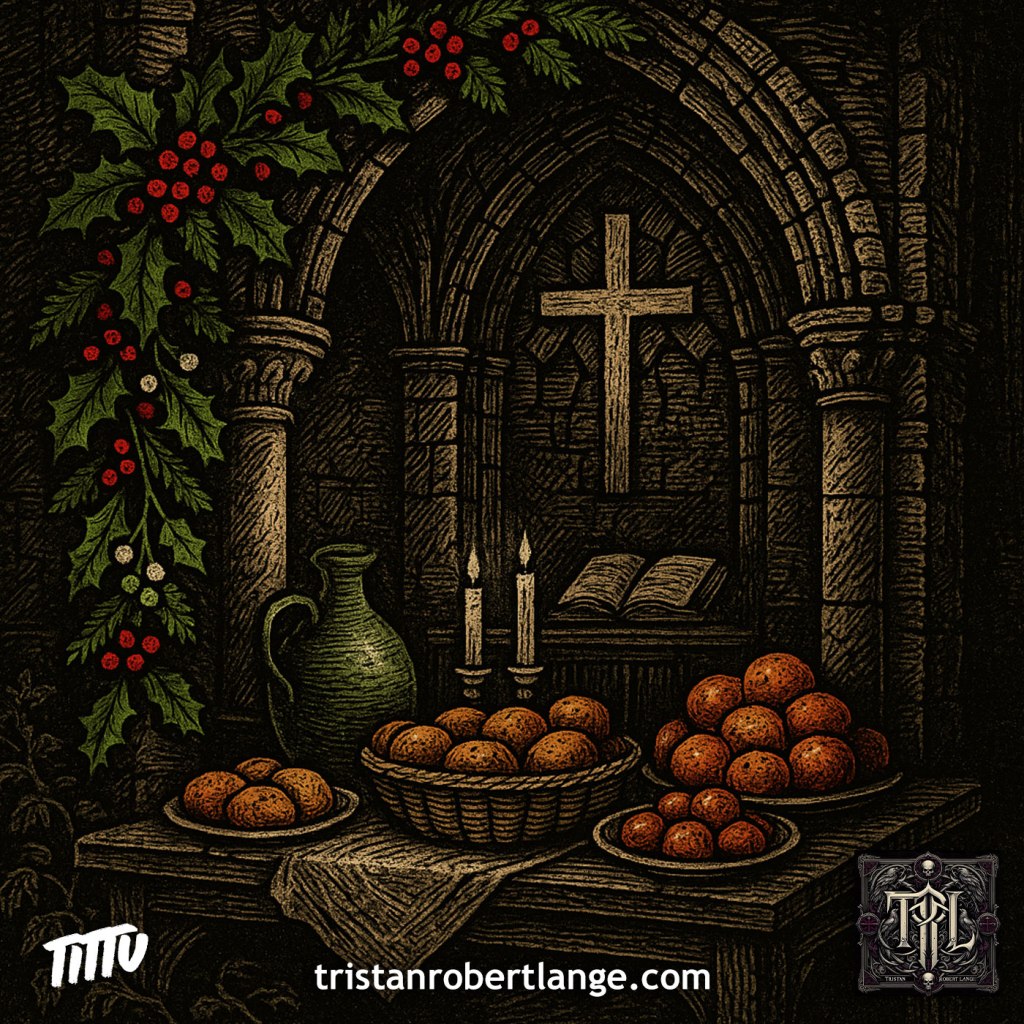
Straight ahead, a simple wooden altar with two plain candles on either end. Between them, a large, hardbound Bible, opened with a purple parament strip laying in the fold down its right page. Behind the bible, a simple, plain, empty brass cross.
On the front panel of the altar, this inscription: “Do his or me.” While no longer practicing, I grew up United Methodist and I know what should be there, “Do this in memory of me.” Standing at the entry, I could just barely make out the existing letters with the minimal light filtering in through—I must confess this shocked the hell out of me—black and red stained-glass windows instead of rippled, textured and clear.
As I walked toward the altar, I also noticed the carpet was fading from deep crimson in the reddish hue from the red stained-glass panes to jet-black ink. Though the distance to walk was short, it grew more treacherous feeling, each step falling into the velvet void—each step’s landing betraying no abyss below.
Upon reaching the low, unadorned, hard-wooden kneeling rail fencing in the front of the chancel, I could see that the missing lettering on the altar, much like the wood panel in the great hall, had been charred black, as if by ivy choking it. Hardly possible, but I am beginning to wonder if these dark markings come from vandals or some other hidden history.
Walking into the chancel area, behind the pulpit, I could see that a sermon was left there from the last time service had been held here. Its pages largely undisturbed, they looked almost as if they were brand new. Every scholar or archivist knows it is a blessing to discover any document produced on acid-free paper… and this era was long before acid was introduced. Despite knowing this, it is always a surprise to see such aged paper look so pure and new.
After a moment of admiration, I carefully placed the pages back in order and began to read.
Our savior Jesus calls us here—
To the great feast with love and cheer!Our halls are filled with Christ’s brethren.
The Lord Jesus Christ calls us here,
So bring to the table no fear.Good men, as the sisters prepare
Our love feast, made for Christ’s brethren,
The Lord Jesus Christ joins us here
To love us as his own children.So, to the table, bring no fear.
Good men, yes the sisters prepare—
For the Lord Christ calls us all here—
A great feast, made for Christ’s brethren.
They love us as their own children.The sweet buns, the flesh—glaze is clear—
Placed on the table with no fear.
Good men, the sisters are aware
That brother Jesus called us here.
A great feast, they make, dear brethren!
They fatten us up like children.At this dark hour be aware—
The sweet buns are flesh—time for beer—
Lay on the table with no fear.
Men failed, the sisters are aware.
A great feast be made, dear brethren,
To fatten us up like children!
Remember, Jesus called us here.We all here have thus been chosen
For this dark hour—be aware—
We’ll lay on the slab showing fear.
Men, you failed! The sisters—aware—
Make a great feast, foulest brethren;
They fattened you up like children
Lilith, not Jesus, called us here—
Let’s to the feast, the time is near!
I must confess that I am not sure what to make of what I just read (included above). It starts off much like a typical Moravian sermon. I could almost hear Count Villeroy’s cadence reverberate like ghost-echoes through the chapel. But—and this is important to note—it twisted from sermon into a vile hymnody. A mockery of what any good Moravian would call whole. I find, to keep my emotions in check, I need to let this be for now and carry on with recording where I went from there onward.
As was known to me already from others’ accounts of this site, there was a staircase behind the altar that led down to an older part of the castle—the part that existed prior to Villeroy’s building and rededication plans. Finding them, I made my descent.
Darkness surrounded me, barring the minimal warm glow of my lamp. The room I entered into was larger than the chapel above. It consisted of a low, slightly arched ceiling. I was standing in the central, circular corridor. Around the perimeter were doors hewn out of stone leading into smaller corridors. Above each door were German words etched in stone: Brüder, Schwestern, Jungen, Mädchen, Witwen, Älteste, Die dem Gebet geweihten Schwestern, and others. Those translate as follows, Brothers, Sisters, Boys, Girls, Widows, Elders, The Sisters of Devoted Prayer (or The Women of Devoted Prayer as it has sometimes been rendered in English) respectively.
It was clear I was standing in the choir vault repurposed from a much older ruin. Immediately, as if the curious little girl in me were bursting forth, I briskly walked toward the Devoted Sisters door, not sure what I could hope to find, but hoping whatever lies in there is evidence that the fabled sister Amelia truly existed. Legend has it that she was the only one to escape the horror of Zindorf, but no one has ever found proof. Just stories passed down, nothing more.
And that is where I find my self now, sitting here and processing things up to this point. From here I am going to further explore this room and see if I can discover anything that will lead me to further understand these sisters and, by God if I am lucky, any evidence of sister Amelia.
Location: Choir Vault, “Die dem Gebet geweihten Schwestern”
Time: 1620
I cannot believe that in only a relatively short while I have come up with solid evidence that Amelia was more than a legendary fabrication for, right here before me I have her very diary, tucked neatly and safely away in one of many wall niches.
Upon opening it I saw Amelia’s name and starting date, written on the inner binding. At last, the proof I had been waiting for. Yet, beyond the initial opening, dread began to settle back in. Here, exactly as it is in her diary, are Amelia’s words:
We’re hungry, we’re hungry you see,
Come on you children, follow me,
To the chapel—forget the beast—
It’s been prepared, to the love feast.Little girls—our sisters—please come,
Can you hear the goddess heart thrum?
The kitchen has fired up the heat,
Cooking us fresh buns from sweet meat.Let’s on up, let’s on up now!
Better than any fatted cow—
Cooked in their own fat, outside crisp,
Aroma travels like a wisp.Dear ones, dear ones, fear do not bear,
The boys are asleep unaware.
The Brethren shall no more instill
Their poison in us—Lilith’s will.“O how? O how?” you ask us clear—
Not realizing the time is here—
Because, dear ones, they are no more.
We got even—settled the score.We’ve kept them, fed them, loved those men—
We slaved away while in their den—
Fattening them up like a beast—
They set our table—our love feast.Eat up dears, you eat up right now!
I only care you do—not how—
It’s your sacred duty, sisters,
To consume those wretched misters.That’s it, that’s it—this, our love feast—
We who love Lilith devour beast.
The sun no longer strips our pride,
As sure as the moon is our guide.
Time: 16:30
I had to pause briefly to collect myself, for as I was reading these most horrifying words I also heard a sound reverberate through the room from the center hall. A voice and, I am not even sure I should be writing this here but will worry about that later, it said this:
Isabella...bella...isa...
freee      ussssss
My name?—The voice said my name. Is someone here pranking me? I continue to hear it call. I must find out its source…
FIELD RECOVERY REPORT
Date: New Year’s Eve 2024
Time: 13:00
Time Zone: CET (UTC+1)
Coordinates: 50.57° N, 12.93° E
Location Description: Zindorf Ruins, Choir Vault, “Die dem Gebet geweihten Schwestern”
Researcher:
Isabella Brenner, PhD.
Moravian University (Bethlehem, PA)
Status: Missing, search ongoing.
Inventory of items recovered: SUV, field journal, satchel, pen, backpack, which also contained a canteen with water, trail mix, extra pens, a tablet, a charging block, a charging wire, a magnifying glass, brushes, a pick hammer, zip ties, and clear zip-seal bags.
Report filled out by:
Jonathan Lautig, Ph.D, Chair
Medieval & Early Modern European History
Department of History
Moravian University
Author’s Note:
This is a work of gothic horror presented as a Dossier Discovery, using field logs, hymns, and recovered documents. Religious language appears as setting and ritual, not theology. It is part of the ongoing Devilishly Dreadful series.
© 2025 Tristan Robert Lange. All rights reserved.
This work is a piece of fiction. Names and institutions are used for narrative purposes only.
Tittu


 Tristan Robert Lange
Leave a comment