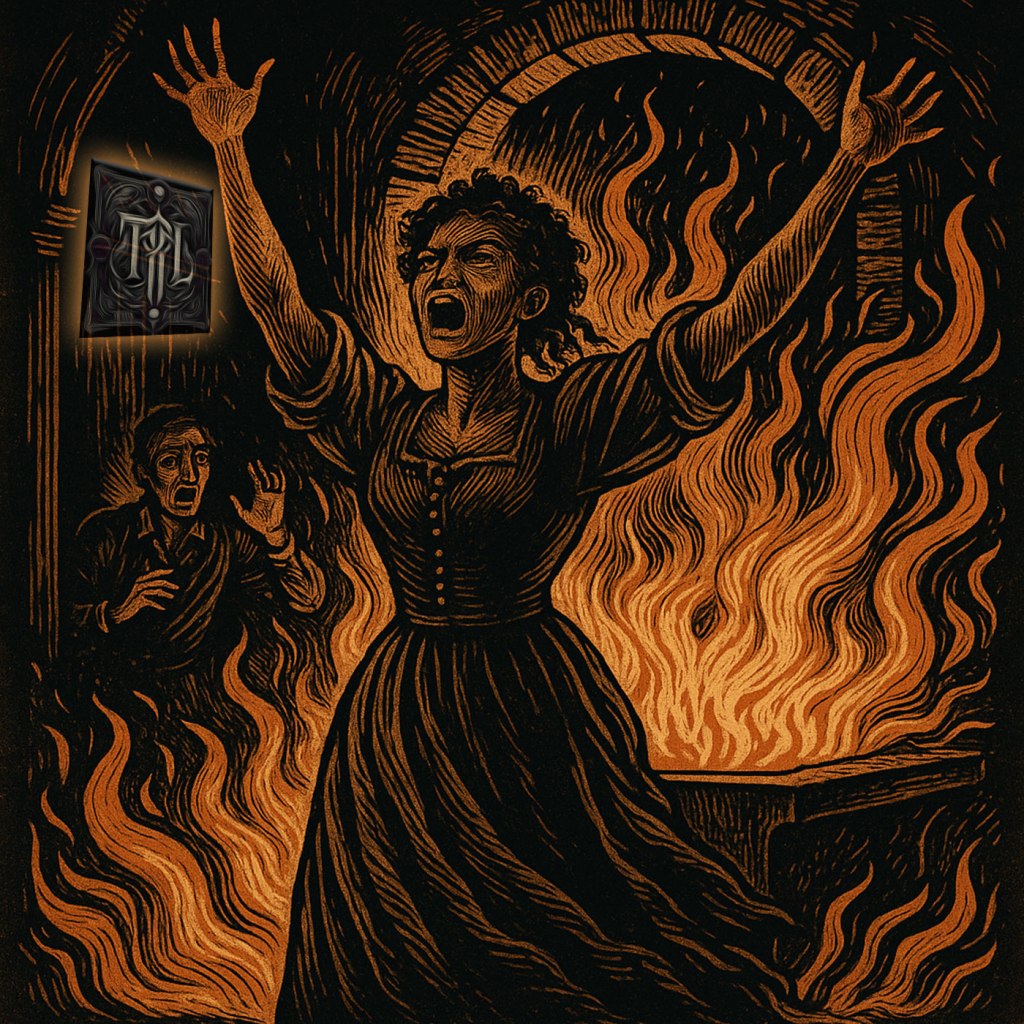
Flames of Betrayal on SoundCloud.
She sat there with shame near the flickering flame,
Bearing betrayal’s name near the flickering flame.
He loved her, she thought—with all of his heart—
Promised to remove her blame in the flickering flame.
She was Black—a free girl—he a northern white;
Her safety was his claim ‘neath the flickering flame.
She believed him and trusted his love for her—
Wed him—became his wife and the flickering flame.
In the forge, she sat there alone in the heat,
Vengeance now her name ‘neath the flickering flame.
She was Black—freeborn—he a white gentleman;
His lies were to blame in the flickering flame.
He loved her, she thought, but she was wrong,
‘Stead, she learned his game ‘neath the flickering flame.
A rich commodity, that Miss Ada was,
He’d sell her in shame sans the flickering flame.
But knowledge is power and she, no slave,
Scorched them both the same in the flickering flame.
Like Tristan and Isolde in horror’s claim,
A Pyre—her forge a frame—the flickering flame.
© 2025 Tristan Robert Lange. All rights reserved.
Tittu
Poet’s Note:
For Macabre Monday. This is the fifth part in my series, Devilishly Dreadful.
Drawing from the 1840s penny dreadful Ada the Betrayed; or, The Murder at the Old Smithy, this reimagining shifts the tale to the Hudson River’s shadowed edge. Here, Ada is a free Black woman whose marriage vows mask her husband’s evil plot. Unlike the original dreadfuls, my telling grants her agency rather than casting her as a tragic damsel in distress—a fate too often imposed on both women and Black characters in classic Western literature. Told as a ghazal, each couplet becomes a shard of fire and betrayal, refraining in the flickering flame until her legend burns eternal.


 Tristan Robert Lange
Leave a comment